
Papers15 Apr
Counting free fermions
A link between the statistical properties of free fermions in one dimension when either half- or alternating- states are initially occupied.

Press15 Apr
Talking is thinking
Talking engages robust muscles of thought—not least when mathematicians take their problems to the blackboard, argues Thomas Hodgkinson.

Papers3 Apr
PCM in arbitrary fields
The first exact solution for the vacuum state of an asymptotically free QFT in a general external field found for the Principal Chiral Model.
Website28 Mar
Soft power
Our new soft power page catalogues all we do that doesn’t directly concern research and fundraising, such as our voice, website and building.

press20 Mar
Congratulations, Sasha
Congratulations to Oleksandr Gamayun and coauthors, whose paper in Nature extends research on solitons that began in a 19th century canal.
Papers20 Mar
Strange kinks
Nature has published the paper “Non-reciprocal topological solitons in active metamaterials” by Oleksandr Gamayun and coauthors.
press18 Mar
Creative convergence
The advertising guru Graham Fink waxes lyrical about equations and working with the London Institute on the How Do You Feel Today? podcast.
press16 Mar
Let's talk about science
For its 225th birthday, our writer Thomas Hodgkinson hails the Royal Institution as proof of the vital importance of science communication.
Papers8 Mar
PCM in arbitrary fields
The journal Physical Review Letters accepts “Large-N principal chiral model in arbitrary external fields” by Evgeny Sobko and coauthors.
press5 Mar
Elliptic curve mystery
Quanta reports on work by Yang-Hui He, who co-discovered unexpected patterns in a property related to the curves’ integer roots using AI.
press29 Feb
Geometry’s dominion
Following his popular Discourse, our Prof. Yang-Hui He and writer Madeleine Hall chat about the mysteries of geometry on the Ri Podcast.
people26 Feb
Assistant to the director
Justine Crean is the assistant to the director at LIMS. She helps manage our scientists and staff and coordinate the Institute’s activities.
jobs22 Feb
Chief graphic designer
The London Institute is recruiting a world-class graphic designer to visualise our mathematical discoveries and enhance our visual identity.
press20 Feb
Security and freedom
A Bloomberg piece names our Arnold and Landau Fellowships as one of the few programmes offering help to Russian and Ukrainian scientists.
Papers16 Feb
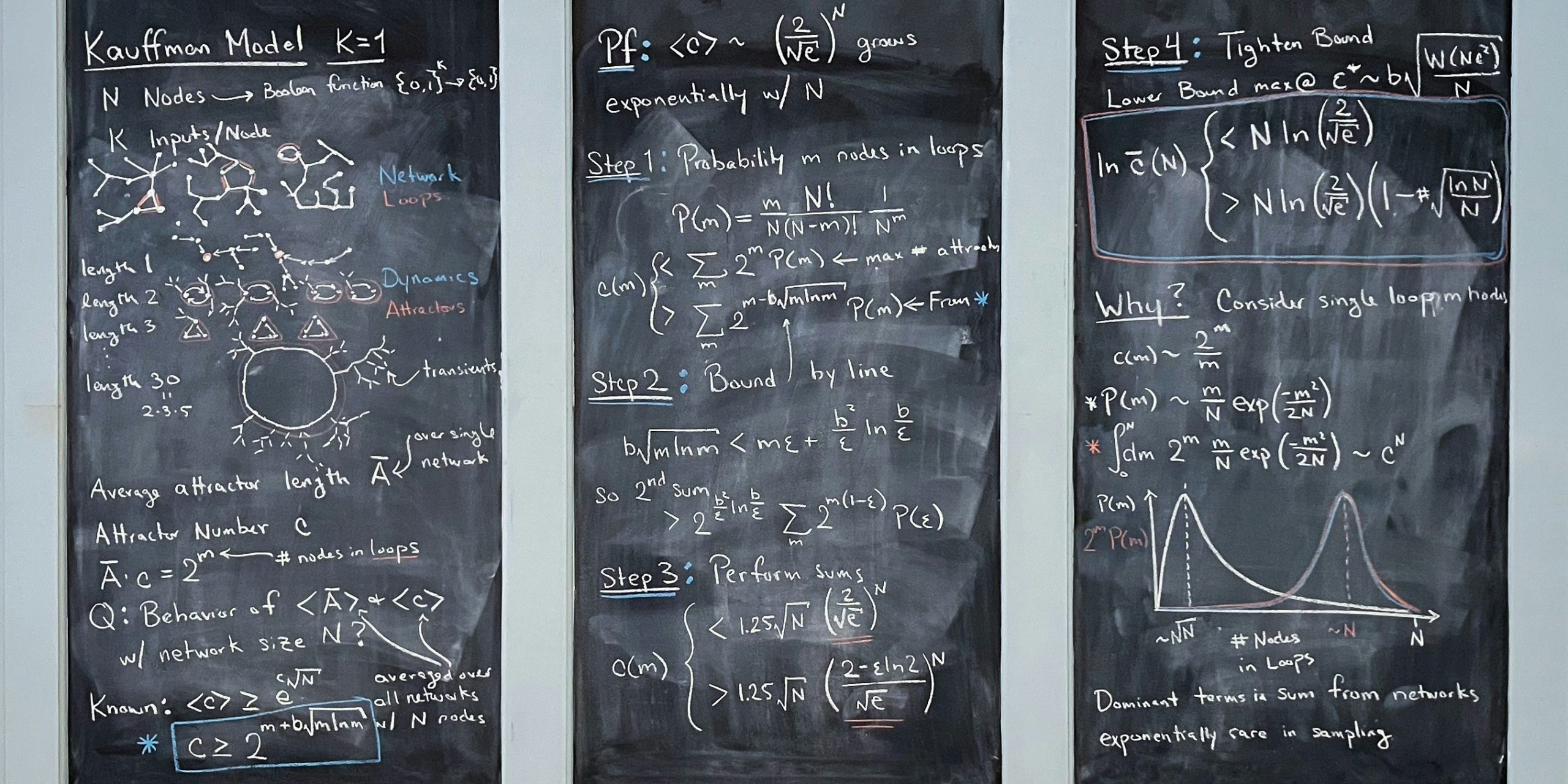
Multiplicative loops
The journal Physical Review Research accepts the paper “Exact dynamics of the critical Kauffman model with connectivity one” by Thomas Fink.
Events12 Feb
A monstrous talent
In the inaugural Simon Norton Lecture, Prof. Peter Cameron celebrates the mathematician's achievements and talks about Norton algebras.
Website12 Feb
Content types
We revised our content types page, which describes the building blocks of our site, and added new building blocks, such as jobs and rituals.
Events9 Feb
London Gravity Meeting
Researchers working on all aspects of gravity, from gravitational waves to black holes, discuss the latest developments in their field.
jobs9 Feb
A&L Junior Fellowships
The London Institute recruited Arman Sarikyan as an Arnold Junior Fellow, one of a few we are recruiting this year. He starts on 1 July 2024.
jobs2 Feb
Finance director
The London Institute is hiring a full-time finance director to help us take our financial health and capacity for growth to the next level.
press30 Jan
AI at the Olympiad
Can AI do maths? In three separate publications, our scientists comment on the latest advances by the researchers at Google DeepMind.
people29 Jan
Chief science writer
Ananyo Bhattacharya is the chief science writer at LIMS. He writes about our research and our institute in the science and mainstream press.
Events26 Jan
St Scholastica’s Feast
We hold an annual formal dinner in our rooms, to mark the anniversary of our founding and affirm our belief in the importance of community.
Website25 Jan
Jobs
Our new Jobs page shows the jobs we are recruiting for and those we have filled, and introduces our standard template for job descriptions.
Papers22 Jan
Strange kinks
The journal Nature accepts the paper “Non-reciprocal topological solitons in active metamaterials” by Oleksandr Gamayun and coauthors.
Papers12 Jan
Spin-charge separation
A transformation for spin and charge degrees of freedom in one-dimensional lattice systems allows direct access to the dynamical correlations.
press11 Jan
The art of blackboards
In a piece in Nautilus, our scientists talk about why they prefer the 1,000-year-old technology of blackboards to their digital equivalents.
press9 Jan
A Birch for AI's back
In a Nature correspondence, our scientists argue that, by the terms of “the Birch test” no AI has yet made a genuine mathematical discovery.
jobs1 Jan
A&L Junior Fellowships
The London Institute is hiring four outstanding young physicists and mathematicians from Russia, Ukraine and Belarus to join us in 2024.
jobs1 Jan
LIMS Junior Fellowships
The London Institute is recruiting two outstanding physicists and mathematicians in the early stages of their career to join us in 2024.
Papers27 Dec 2023
Kauffman cracked
Surprisingly, the number of attractors in the critical Kauffman model with connectivity one grows exponentially with the size of the network.
Papers18 Dec 2023
Spin-charge separation
Physical Review A accepts “Emergence of anyonic correlations from spin and charge dynamics in one dimension” by Oleksandr Gamayun et al.
Papers5 Dec 2023
The limits of LLMs
It’s a mistake to credit large language models with human levels of reason and other abilities. To use them well, we must know their limits.
Press5 Dec 2023
It’s happening now
The permanent revolution of AI means companies must do more than just adapt to the latest advance. They must become more adaptable.
Papers5 Dec 2023
Mobile impurity
Explicit computation of injection and ejection impurity’s Green’s function reveals a generalisation of the Kubo-Martin-Schwinger relation.
Papers27 Nov 2023
Black hole symmetry
Effective field theories for Kerr black holes show that the 3-point Kerr amplitudes are uniquely predicted using higher-spin gauge symmetry.
Website19 Nov 2023
Rituals
Our new Rituals page describes the processes and traditions that the London Institute has developed over the years, which form our culture.
Papers17 Nov 2023
Kauffman cracked
Physical Review Letters accepts “Number of attractors in the critical Kauffman model is exponential” by Thomas Fink and Forrest Sheldon.
Events16 Nov 2023
London Gravity Meeting
Researchers working on all aspects of gravity, from gravitational waves to black holes, discuss recent developments in the field.
Events1 Nov 2023
Listening to maths
The luthier Robert Brewer Young explains the geometry of the violin, with musical accompaniment on two violins made by Stradivari himself.
people30 Oct 2023
Welcome, Vyacheslav
Dr Vyacheslav Lysov is our new Arnold Fellow. He works on tropical mirror symmetry, supersymmetric localisation and asymptotic symmetries.
Website11 Oct 2023
Values
Our values are the fundamental organising principles of the London Institute. They determine what we do, how we do it, and who we recruit.
Papers10 Oct 2023
Black hole symmetry
Physical Review Letters accepts the paper “Kerr black holes from massive higher-spin gauge symmetry” by Alexander Ochirov and coauthors.
Papers27 Sep 2023
Strange kinks
A new non-linear mechanical metamaterial can sustain topological solitons, robust solitary waves that could have exciting applications.
Papers15 Sep 2023
Recursively divisible numbers
“Recursively divisible numbers” is accepted by the Journal of Number Theory, which introduces a recursive analog of the divisor function.
People6 Sep 2023
Welcome, Evgeny
Dr Evgeny Sobko is our new Landau Fellow. His research focuses on exactly solvable models in quantum field and string theory.
press5 Sep 2023
Science goes pro
Professional sport has a lot to teach scientists about pushing the limits of human achievement—so why are we still content to be amateurs?
PEOPLE21 Aug 2023
Welcome, Federico
Dr Federico Carta is our new Leverhulme Postdoctoral Fellow. His research is in string theory, string phenomenology and quantum field theory.
Papers15 Aug 2023
Mobile impurity
Explicit computation of injection and ejection impurity’s Green’s function reveals a generalisation of the Kubo-Martin-Schwinger relation.
Events24-25 AUG
DANGER
The London Institute hosts a two-day workshop for theorists to discuss and explore the links between data science, AI and pure mathematics.
Papers3 Aug 2023
Spin diffusion
SciPost Physics accepts the paper “Finite temperature spin diffusion in the Hubbard model in the strong coupling limit” by Dr Oleksandr Gamayun et al.
PEOPLE27 Jul 2023
Welcome, Andrei
Dr Andrei Stepanenko is our new Landau Junior Research Fellow. He works on topological photonics, combining topology and quantum computing.
Events25 Jul 2023
Converging futures
The London Institute brings together experts from the worlds of finance and AI to discuss the potential and the pitfalls of AI-driven markets.
Papers25 Jul 2023
Counting recursive divisors
Three new closed-form expressions give the number of recursive divisors and ordered factorisations, which were until now hard to compute.
Papers21 Jul 2023
Bundled Laplacians
JHEP publishes the paper “Numerical spectra of the Laplacian for line bundles on Calabi-Yau hypersurfaces” co-authored by Prof. Yang-Hui He.
Papers20 Jul 2023
Infinite-dimensional irreducibility
An analog of quasi-regular representations can be constructed for an infinite-dimensional group, despite the absence of the Haar measure.
Papers17 Jul 2023
Recursive divisor properties
The recursive divisor function has a simple Dirichlet series that relates it to the divisor function and other standard arithmetic functions.
Papers14 Jul 2023
Absorption with amplitudes
How gravitational waves are absorbed by a black hole is understood, for the first time, through effective on-shell scattering amplitudes.
Papers13 Jul 2023
Peculiar betas
The beta function for a class of sigma models is found not to be geometric, but rather has an elegant form in the context of algebraic data.
Papers12 Jul 2023
DeepPavlov dream
A new open-source platform is specifically tailored for developing complex dialogue systems, like generative conversational AI assistants.